The Best Non-Toxic Cookware in 2026
The best non-toxic cookware, ranked by material. Which PFAS-free pans are worth buying, how long ceramic really lasts, and what labels don't tell you.

Last updated September 2026. Detox Database may earn a commission from links on this page. It never affects our ratings.
Cookware is the one purchase in a non-toxic kitchen that touches every meal you make.
It's also the category with the most confusing labels: "PFOA-free," "ceramic," "non-toxic," and "PFAS-free" all mean different things, and only one of them is meaningful.
The safest cookware has no synthetic coating at all: stainless steel, cast iron, and carbon steel. Ceramic nonstick is a genuine improvement over Teflon, but it wears out faster than most brands admit.
Below is how each material performs, our picks in every category, and the trade-offs nobody mentions.
What Makes Cookware Non-Toxic?
Non-toxic cookware is made without PFAS ("forever chemicals"), lead, and cadmium, and it doesn't shed coating into your food.
Stainless steel, cast iron, and carbon steel have no synthetic coating at all. Ceramic-coated cookware is PFAS-free but has a much shorter lifespan.
"Non-toxic" itself isn't a regulated term, so on a label it can mean almost anything.
The Problem With Traditional Nonstick
Conventional nonstick is coated with PTFE (Teflon), which is part of the PFAS family. Two things happen as it ages.
It sheds into your food. Researchers from Newcastle University and Flinders University measured what comes off nonstick pans during cooking and washing.
They found that a single surface crack on a Teflon-coated pan can release about 9,100 plastic particles, and that broken coating may release 2.3 million microplastics and nanoplastics.
One of the researchers noted that because Teflon belongs to the PFAS family, these particles in food may be a health concern that needs investigating.
Notably, their testing found the coating can release particles over time even without visible damage.
It releases fumes when overheated. PTFE begins breaking down above roughly 500°F, producing fumes that can cause flu-like symptoms in people and can be fatal to pet birds.
Why "PFOA-free" isn't the reassurance it sounds like
PFOA was phased out of U.S. manufacturing years ago, so the claim is close to meaningless today.
Worse, it isn't always accurate. When Consumer Reports tested three nonstick pans to check PFOA-free claims, one PTFE pan actually contained PFOA.
CR no longer displays "PFOA-free" in its cookware ratings at all.
The reason is that PFOA can form as a manufacturing byproduct even when it isn't deliberately added. And a pan can be free of PFOA and PTFE while still containing other PFAS, of which there are thousands.
What to look for instead: an explicit PFAS-free claim backed by published third-party testing, or simply cookware with no coating at all.
State Laws Are Changing the Cookware Aisle
Minnesota's Amara's Law took effect January 1, 2025, banning the sale of products with intentionally added PFAS in 11 categories, cookware included.
The state defines cookware broadly: pots, pans, skillets, grills, baking sheets, trays, bowls, and cooking utensils, plus electric versions like waffle makers and even air fryers if they include a nonstick-coated component.
By 2032, Minnesota will prohibit nonessential PFAS use across the board.
Because manufacturers rarely make state-specific products, this is quietly reshaping what's available everywhere.
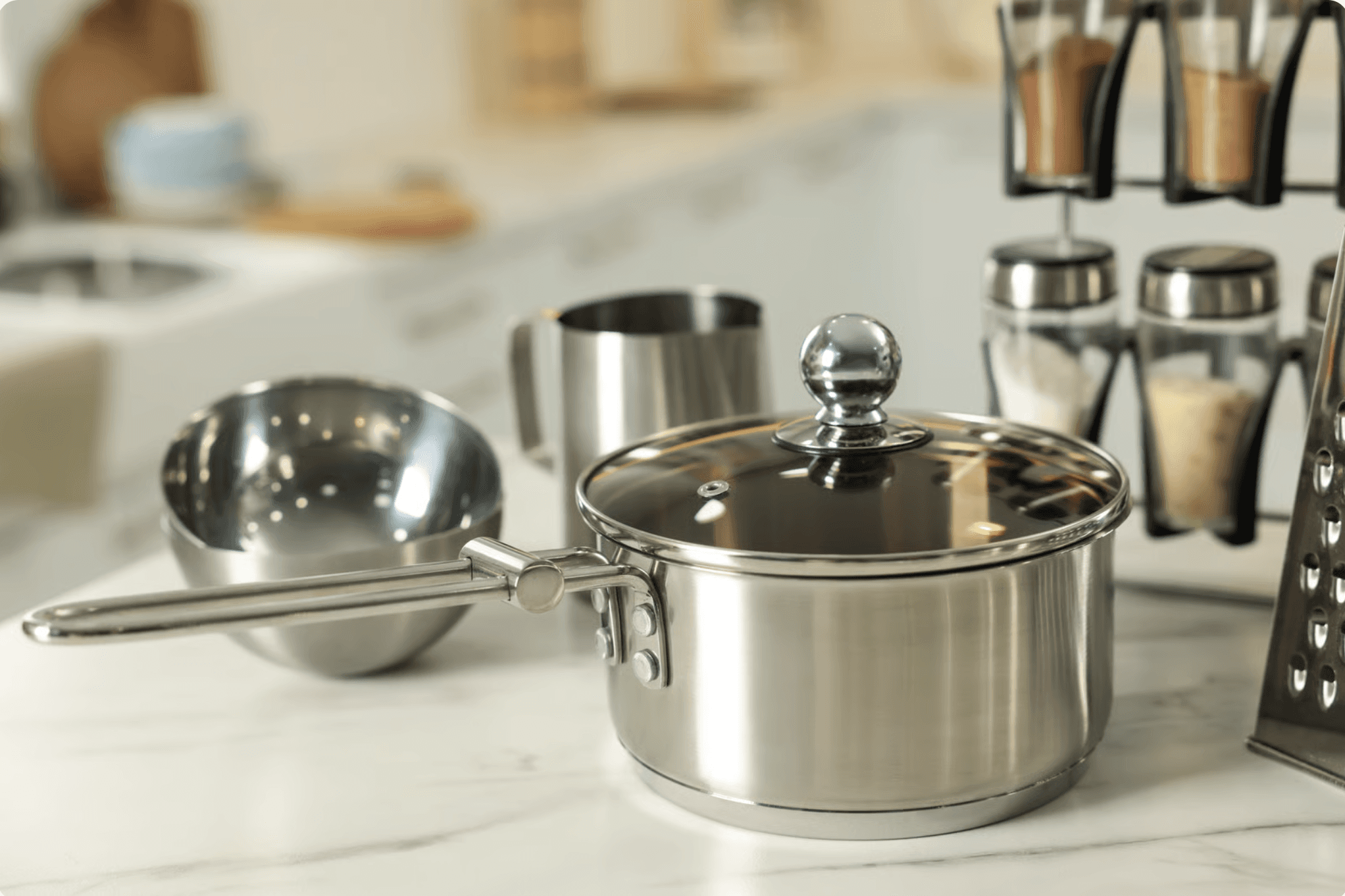
The Best Non-Toxic Cookware
1. All-Clad D3 Stainless - Best Overall
After extended testing, Homes & Gardens named the All-Clad D3 Stainless 3-ply bonded set its top pick for non-toxic cookware, citing even heating and reliable searing on all cooktops.
Tri-ply construction means the aluminum core is fully clad in stainless steel, so no aluminum touches your food.
Pros: No coating to degrade, lasts decades, oven and induction safe, handles acidic foods
Cons: Food sticks without proper technique (preheat, then add fat); expensive up front
Best for: The one pan set most people should build a kitchen around
2. Lodge Cast Iron Skillet - Best Budget Pick
For around $25 to $35, a Lodge skillet is the cheapest genuinely non-toxic pan you can buy, and it will outlive you.
It's made of iron and seasoned with vegetable oil, with zero PFAS risk.
Pros: Inexpensive, lasts generations, naturally nonstick once seasoned, great for searing and baking
Cons: Heavy; needs seasoning and hand washing; not ideal for long-simmered acidic dishes
Best for: Steaks, cornbread, roasted vegetables, and anyone starting on a budget
3. Staub Dutch Oven / Braiser - Best for Braising
Enameled cast iron gives you cast iron's heat retention with a surface that handles tomatoes and wine without stripping seasoning.
The Staub Cast Iron Stackable Set is also a good option for small kitchens, combining professional-quality enameled cast iron with a nesting design.
Pros: No seasoning required, safe for acidic foods, lasts decades, beautiful
Cons: Heavy and expensive; enamel can chip if dropped or shocked with cold water
Best for: Soups, stews, braises, and bread
4. Caraway - Best Ceramic Nonstick
If you want true nonstick convenience, Caraway is the most popular pick for good reason: its ceramic coating is free of PTFE, PFOA, PFAS, lead, and cadmium, and the sets include a magnetic storage rack that's more useful than it sounds.
But go in with realistic expectations. Independent long-term testing shows staining, scratches, and loosening handles around the one-year mark, and like all ceramic coatings, expect 1 to 3 years of life with regular use.
Use it gently: low to medium heat, silicone or wooden utensils, hand washing only.
Pros: Excellent nonstick performance, no PFAS, attractive design, good for eggs and fish
Cons: Short lifespan; not for high-heat searing; dishwasher and metal utensils will kill it
Best for: Eggs, pancakes, delicate fish, and anyone transitioning away from Teflon
5. GreenPan - Best Budget Ceramic
GreenPan pioneered ceramic nonstick with its Thermolon coating, a silica-based sol-gel surface rather than PTFE, and it's the most affordable way into the category. Same lifespan caveats apply.
Pros: Affordable, widely available, PFAS-free ceramic coating
Cons: Same 1 to 3 year lifespan; lower-end lines wear faster
Best for: Replacing Teflon pans without a big investment
6. Xtrema - Best Coating-Free Nonstick Alternative
Xtrema makes cookware that is fully ceramic to the core rather than ceramic-coated, so there's no coating to scratch or wear off and no metal in contact with food at all.
Pros: Nothing to degrade, no metals, oven and broiler safe, easy to clean
Cons: Heats slower than metal, can crack if dropped or thermally shocked, not truly nonstick
Best for: People who want to eliminate coatings and metal leaching entirely
7. Made In - Best for Searing
Carbon steel is the professional chef's answer to nonstick: lighter than cast iron, heats faster, and builds a slick seasoned surface over time with no coating whatsoever.
Pros: No coating, lasts a lifetime, excellent high-heat searing, lighter than cast iron
Cons: Needs seasoning and hand-drying; acidic foods strip the seasoning
Best for: Steaks, stir-fries, and anyone who wants naturally nonstick without ceramic
How to Make Non-Toxic Cookware Last
Preheat stainless before adding fat. Heat the dry pan, add oil, then add food. This is the single technique that makes stainless behave almost like nonstick.
Never heat any coated pan empty, and keep ceramic on low to medium heat.
Use wood, silicone, or nylon utensils on any coated surface. Metal utensils are the fastest way to ruin a ceramic pan.
Skip aerosol cooking sprays on coated pans. They leave a residue that builds up and destroys the nonstick surface.
Hand wash coated pans. Dishwashers accelerate coating breakdown.
Avoid thermal shock. Don't run cold water over a hot pan, which cracks enamel and degrades ceramic.
Dry cast iron and carbon steel immediately and wipe with a thin coat of oil.
What to Do With Your Old Nonstick Pans
You don't have to replace everything at once. Prioritize by condition:
Replace immediately any pan with visible scratches, flaking, or chipped coating, since that's when particle shedding is highest.
Keep intact pans for lower heat in the meantime, never above medium, never preheated empty, and always with good ventilation.
Start with the pan you use most, usually a skillet. One good stainless or cast iron skillet handles the majority of cooking.
Move pet birds out of the kitchen entirely while using PTFE cookware.
Frequently Asked Questions
What is the safest cookware to use?
Stainless steel, cast iron, and carbon steel are the safest because they have no synthetic coating that can degrade or shed. Enameled cast iron and 100% ceramic are also excellent. Ceramic-coated nonstick is safe but has a much shorter lifespan.
Is ceramic cookware really non-toxic?
Ceramic coatings are PFAS-free and a real improvement over PTFE. The main caveat is durability: most last 1 to 3 years, and brands rarely disclose their exact coating formulas.
Is stainless steel cookware safe?
Yes for the vast majority of people. It does leach small amounts of nickel and chromium into acidic foods, especially when new and during long cooking, but the amounts fall within ranges regulators consider safe. People with nickel allergies may prefer nickel-free stainless, enamel, or cast iron.
Is cast iron safe to cook with every day?
Yes, and it can increase the iron content of your food, which benefits many people. If you have hemochromatosis or have been advised to limit iron, use it less often for acidic, long-cooked dishes.
Do I need to throw out my Teflon pans?
Replace any pan that's scratched, flaking, or chipped, since damaged coating sheds the most particles. Intact pans used at low to medium heat pose less risk, but replacing your most-used pan first is the highest-impact change.
Is "PFOA-free" the same as PFAS-free?
No. PFOA is one chemical in a family of thousands, and Consumer Reports even found PFOA in a pan labeled PFOA-free. Look for explicit PFAS-free claims with third-party testing.
What about aluminum cookware?
Bare aluminum can leach into acidic foods. Fully clad construction, where aluminum is sandwiched between layers of stainless steel, solves this while keeping aluminum's excellent heat conduction.
The Bottom Line
The best non-toxic cookware strategy isn't one pan, it's two or three.
A tri-ply stainless skillet for everyday cooking, a cast iron or carbon steel pan for searing, and an enameled Dutch oven for braises will cover almost everything and last for decades.
Add one ceramic nonstick pan for eggs if you want it, and accept that you'll replace it every couple of years.
