The Best Non-Toxic Nail Polish in 2026
The best non-toxic nail polishes of 2026, from water-based to 10-free. What "free" labels leave out, why TPHP matters, and what to know about gel polish.

Last updated September 2026. Detox Database may earn a commission from links on this page. It never affects our ratings.
Nail polish is one of those products most people never think twice about.
But the sharp smell of a fresh coat is a clue: conventional polish is built on solvents and plasticizers, and research shows at least some of those ingredients don't stay on your nails.
Non-toxic nail polish has come a long way, and today's cleaner formulas look and wear far better than they did a decade ago.
But the category is also full of numbers ("5-free," "10-free," "21-free") that sound precise and aren't.
Below are our top picks, what those labels actually mean, and what you need to know before your next gel manicure.
Is Nail Polish Toxic?
Conventional nail polish contains solvents, plasticizers, and resins, some of which are linked to hormone disruption, respiratory irritation, and allergic reactions.
Most of the exposure comes from breathing fumes while polish dries and from ingredients absorbed through the skin around your nails.
Non-toxic nail polish either removes the most concerning ingredients (the "free-from" approach) or replaces solvents with water entirely.
It's worth being honest up front: there's no such thing as a completely non-toxic solvent-based nail polish.
Even many "10-free" and "21-free" formulas still rely on volatile solvents, film-formers, and regulated color additives to get long wear and shine.
That doesn't make them pointless. It means the goal is reducing exposure, not eliminating it.
What "3-Free," "10-Free," and "21-Free" Mean
The "free" numbers started with the toxic trio: formaldehyde, toluene, and dibutyl phthalate (DBP), the three chemicals conventional polish relied on for decades.
Brands then added more ingredients to their exclusion lists:
3-free: No formaldehyde, toluene, or DBP.
5-free: Also free of formaldehyde resin and camphor.
8-free: Typically adds ethyl tosylamide, triphenyl phosphate (TPHP), and xylene.
10-free: Often adds parabens and tert-butyl hydroperoxide.
15-free, 21-free, and beyond: Longer lists that vary brand to brand.
Here's the catch: no agency decides which ingredients go on those lists, so two brands can both say "10-free" and mean different things.
Some brands pad their lists with ingredients that were never standard in nail polish, making the number look impressive without changing the formula much.
A higher number can reflect a genuinely thoughtful formula.
But the ingredient list on the back of the bottle always tells you more than the number on the front.
Why You Can't Always Trust the Label
In 2012, California's Department of Toxic Substances Control (DTSC) tested 25 nail care products sold to salons.
Twelve claimed to be free of at least one toxic trio chemical. The results:
10 of the 12 products claiming to be toluene-free actually contained toluene, four at dangerously high levels.
5 of 7 products labeled "3-free" contained one or more of those chemicals at significant levels.
Some "toxic-free" products contained more DBP or toluene than products that made no claims at all.
The DTSC's director put it bluntly, saying some manufacturers failed both to know what was in their products and to accurately state what was there.
The market has improved since then, but the lesson holds: buy from brands that publish full ingredient lists, not just a number.
Nail Polish Ingredients to Avoid
Formaldehyde and formaldehyde resin
Used as a hardener. Formaldehyde is a known carcinogen and common skin allergen, and formaldehyde resin (tosylamide/formaldehyde resin) is a frequent cause of allergic reactions around the nails and even on the eyelids and face from touching them.
Toluene
A solvent that helps polish go on smoothly. Exposure to large amounts is linked to developmental problems, asthma, and other illnesses, and it's a major concern for salon workers breathing it all day.
Dibutyl phthalate (DBP)
A plasticizer that keeps polish flexible. It fell out of use after research showed phthalates are likely endocrine disruptors and toxic to the reproductive system.
Triphenyl phosphate (TPHP): the "regrettable substitute"
This is the one most people haven't heard of. When brands dropped DBP, many likely turned to TPHP as a replacement plasticizer.
TPHP is also used in plastics manufacturing and as a fire retardant in foam furniture.
A 2015 study by researchers at Duke University and the Environmental Working Group tested the urine of 26 women after they painted their nails and found evidence of TPHP in every participant.
Levels of its metabolite rose nearly sevenfold within 10 to 14 hours. TPHP is a suspected endocrine disruptor, and in animal studies it has caused reproductive and developmental irregularities.
Clear polishes and top coats generally contained more TPHP than colored polishes, so check your base and top coats too.
Camphor
Adds gloss but can irritate skin and cause reactions when inhaled in high amounts.
Xylene
A solvent similar to toluene, with similar concerns about fume exposure.
Water-Based Nail Polish
If you want the biggest reduction in exposure, water-based polish is it.
These formulas replace traditional solvents with water, are typically low-odor, and come off without acetone. They're the lowest-risk option for at-home manicures.
The trade-off is performance: water-based polish usually offers shorter wear time and fewer finish options.
It's a great choice for kids, pregnancy, and anyone sensitive to fumes. For a manicure that lasts a week or more, a well-formulated 10-free polish is the more practical pick.
What About Gel Polish?
Gel manicures raise three separate concerns, and they're worth understanding before your next appointment.
1. TPO, now banned in Europe
TPO (trimethylbenzoyl diphenylphosphine oxide) is a photoinitiator, the ingredient that makes gel polish harden under a UV or LED lamp.
The EU banned TPO in cosmetics starting September 1, 2025, and salons there had to discard existing TPO products immediately.
European regulators classified it as a reproductive toxicant after animal studies showed testicular abnormalities and reduced fertility.
For balance: the rats in those studies were repeatedly fed high doses of TPO, far more than you'd be exposed to through a manicure, and gel polish itself isn't banned in Europe, only formulas containing TPO.
In the U.S., TPO remains legal. If you get gel manicures, ask your salon for TPO-free gel, which many brands already make because they reformulated for Europe.
2. HEMA and acrylate allergies
Gel and acrylic nails are built on (meth)acrylate chemicals, and dermatologists have warned about a rise in allergies to them.
In 2018, the British Association of Dermatologists called it a contact allergy epidemic after an audit found 2.4% of people tested were allergic to at least one (meth)acrylate.
HEMA was the most common culprit, with 1.5% testing positive.
Reactions can include loosening nails and a severe itchy rash, sometimes far from the fingertips, and rarely breathing problems.
Sensitization happens when uncured product touches skin, which is most likely with DIY kits or undertrained technicians.
There's also a lasting consequence: once you're sensitized, you may react to acrylates used in dental treatments and surgeries.
Look for HEMA-free gel, and be especially careful with at-home kits.
3. UV lamp exposure
A 2023 study by researchers at UC San Diego, published in Nature Communications, found that a single 20-minute session under a UV nail dryer caused 20 to 30% cell death in the cells studied, and three consecutive sessions killed 65 to 70%.
Surviving cells showed DNA damage and mutations resembling those seen in human skin cancers.
The researchers were careful to say this was a lab study on cells, and that large epidemiological studies, likely taking a decade or more, are needed to quantify real-world cancer risk.
Reasonable precautions in the meantime: apply sunscreen or wear fingerless UV-protective gloves during curing, and space out gel manicures.
How We Rate Nail Polish
Every nail polish in the Detox Database is scored on full ingredient disclosure, the absence of the ingredients above (including TPHP in base and top coats), formula type (water-based vs. solvent-based), third-party verification, and real-world wear. We read the full ingredient list, not just the "free" number.
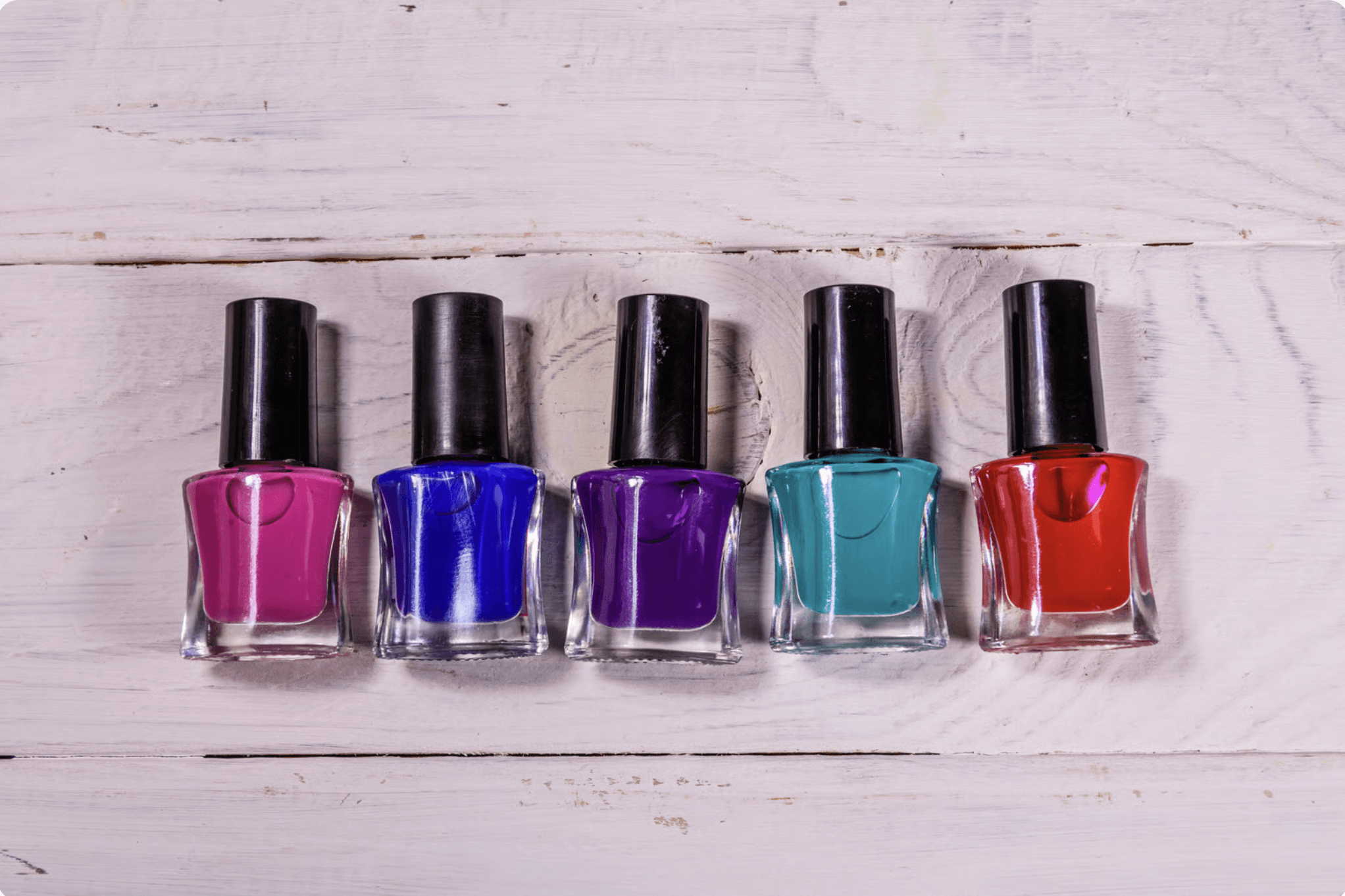
The Best Non-Toxic Nail Polishes
1. Ella+Mila - Best Overall
Ella+Mila hits the best balance of clean formula and real performance.
Its 17-free formula, wide color range, strong wear, and full ingredient disclosure make it the top pick. That last point matters most: you can check exactly what's in every bottle.
Pros: 17-free, full ingredient disclosure, wide color range, wears like conventional polish
Cons: Still a solvent-based formula with fumes while drying; pricier than drugstore brands
Best for: Anyone who wants a long-lasting manicure with a cleaner formula
2. Zoya - Best Shade Range
Zoya is one of the most established names in cleaner polish, with an enormous collection of shades from soft nudes to bold reds, deep purples, and vibrant blues.
The formulas are 10-free and vegan, apply smoothly, and cover in two coats with good chip resistance.
Pros: Huge shade selection, 10-free, vegan, salon-quality wear
Cons: Solvent-based; check individual shades and top coats for full ingredient lists
Best for: Color lovers who change their polish often
3. Sundays - Best Minimalist, Salon-Quality Pick
Sundays started as a clean nail studio, and its polish is 10-free, cruelty-free, and vegan.
The shade range leans toward soft neutrals, muted pastels, and elegant everyday colors, packaged in minimalist, numbered bottles.
Pros: 10-free, vegan, beautiful curated palette, salon heritage
Cons: Smaller shade range; premium price
Best for: Neutral and everyday manicures
4. Kapa Nui - Lowest Chemical Exposure
If you want the cleanest formula possible for adults, Kapa Nui is the standout.
It's water-based, made mostly of water and an acrylates copolymer, with mineral pigments for color. That means very low odor and no harsh solvent fumes while it dries.
Pros: Water-based, minimal ingredients, very low odor, no acetone needed to remove
Cons: Shorter wear time than solvent-based polish; fewer finishes
Best for: Pregnancy, fume sensitivity, and anyone prioritizing minimal exposure
5. Piggy Paint - Best for Kids
Piggy Paint is the go-to kids' polish for good reason.
The ingredient list is short: water, acrylates copolymers, and neem oil, plus mineral and cosmetic pigments. It's free of formaldehyde, toluene, phthalates, BPA, ethyl acetate, and acetone.
Wear depends heavily on application. Reviewers report getting about a week of wear when they apply two to three thin coats and let the polish cure overnight, and the brand's top coat noticeably reduces chipping.
Pros: Water-based, low odor, short ingredient list, removes without acetone
Cons: Needs proper curing to last; contains a synthetic color additive in some shades
Best for: Kids, and adults who want a low-odor polish
6. Suncoat Girl - Best Peel-Off for Kids
Suncoat Girl is designed for children 3 and older and uses water and acrylate copolymer with mineral-based pigments.
It's formulated without phthalates, toluene, formaldehyde, acetates, alcohol, glycol ethers, or FD&C dyes.
It peels off after soaking nails in warm water, so there's no remover at all, which is ideal for little kids.
Just expect it to last only a couple of days on fingernails, longer on toenails.
Pros: Very clean formula, no remover needed, virtually odor-free
Cons: Short wear time; less vibrant than solvent polish
Best for: Young kids, parties, and travel
Don't Forget Your Base Coat, Top Coat, and Remover
Base and top coats are where TPHP tends to hide, since clear formulas contained more of it in testing. Use a base and top coat from the same clean brand as your color.
Nail polish remover: Acetone is effective and fast-evaporating but very drying. Non-acetone removers are gentler on nails but often contain other solvents and take longer. Either way, use it in a ventilated room and follow with a moisturizer. Water-based and peel-off polishes skip remover entirely.
Tips for a Healthier Manicure
Ventilate. Paint your nails near an open window or with a fan running.
Choose salons carefully. Look for good ventilation, and ask what brands they use. Many salons now stock 10-free polish on request.
Give nails a break between gel manicures to reduce acrylate and UV exposure.
Protect your skin during curing with sunscreen or UV-blocking gloves.
Keep polish off your skin, especially gel, which should never touch the skin uncured.
Frequently Asked Questions
What is the least toxic nail polish?
Water-based polishes like Kapa Nui, Piggy Paint, and Suncoat are the least toxic because they replace traditional solvents with water. For longer wear, a fully disclosed 10-free or higher polish like Ella+Mila is the best balance.
Is 21-free better than 10-free?
Not necessarily. There's no standard for these numbers, and some brands add ingredients that were never common in polish to inflate the count. Compare full ingredient lists instead.
Is gel nail polish toxic?
Gel polish carries different risks from regular polish: acrylate allergies (especially HEMA), UV lamp exposure, and TPO, which is banned in the EU but still legal in the U.S. If you get gels, choose HEMA-free and TPO-free formulas and protect your skin during curing.
Is nail polish safe during pregnancy?
Many people choose water-based polish during pregnancy to minimize exposure to solvents and plasticizers like TPHP. Painting in a well-ventilated space helps too. Ask your doctor if you have specific concerns.
What nail polish is safe for kids?
Water-based, peel-off, or low-odor polishes like Piggy Paint and Suncoat Girl are the safest choices for kids, since children are more likely to put their fingers in their mouths.
Why was TPO banned in Europe?
European regulators classified TPO as toxic to reproduction based on animal studies showing reduced fertility. The U.S. hasn't banned it, but TPO-free gel formulas are widely available.
The Bottom Line
For most people, Ella+Mila is the best non-toxic nail polish: a fully disclosed 17-free formula that wears like conventional polish.
If you want the lowest possible exposure, switch to a water-based polish like Kapa Nui, and for kids, Piggy Paint is the standard.
If you love gel manicures, ask for HEMA-free and TPO-free formulas and protect your hands during curing.
